“Remote Hands” vs “Smart Hands” Services
Modern IT infrastructure is increasingly managed remotely. Servers, network equipment, and data storage systems are hosted in commercial data centers, often located in different countries and time zones. At the same time, businesses expect the same level of control, availability, and predictability as if the equipment were located in their own on-premises server room.
In this context, remote technical support models provided by data centers – Remote Hands Services and Smart Hands – are widely used. These terms have become standard for colocation operators and service providers; however, in practice, the distinction between them is often unclear. As a result, basic support is expected to provide engineering expertise, while extended support is expected to assume full responsibility for the infrastructure.
The issue lies not in the terminology itself, but in incorrect expectations. Remote Hands and Smart Hands address different tasks and are embedded in different operational models. Mistakes at this level lead to prolonged incidents, improper escalation, and increased operational risk.
What Are Remote Hands Services
Remote Hands are a basic form of remote technical support in which data center staff perform physical operations on customer equipment according to clearly defined instructions. The executor does not analyze the reason for the request and does not make technical decisions, but operates strictly within the described scenario.
Remote Hands effectively act as a physical extension of the customer’s remote team, providing access to equipment without requiring the customer’s own engineers to be present on site.
Scope of responsibility
The responsibility of Remote Hands is limited to the correct execution of the requested actions. If an operation is performed according to the instructions, the data center is not responsible for the subsequent behavior of the system.
- the data center is responsible for accuracy and timely execution
- the customer is responsible for the correctness of the instructions and architectural decisions
Typical Remote Hands tasks
Remote Hands are used for standard and repetitive operations:
- rebooting servers and network devices
- connecting and disconnecting network and power cables
- replacing pre-prepared components
- visual inspection of indicators
- inserting or removing media
- taking photos of equipment and racks
Level of expertise
Remote Hands are performed by on-duty data center technicians who are well familiar with the facility’s physical infrastructure and access rules, but do not delve into the logic of the customer’s systems and do not perform diagnostics.
Operational boundaries
Remote Hands operate within a standardized SLA and a defined catalog of operations. Any task outside these boundaries requires separate approval or escalation to a different support model.
What Are Smart Hands Services
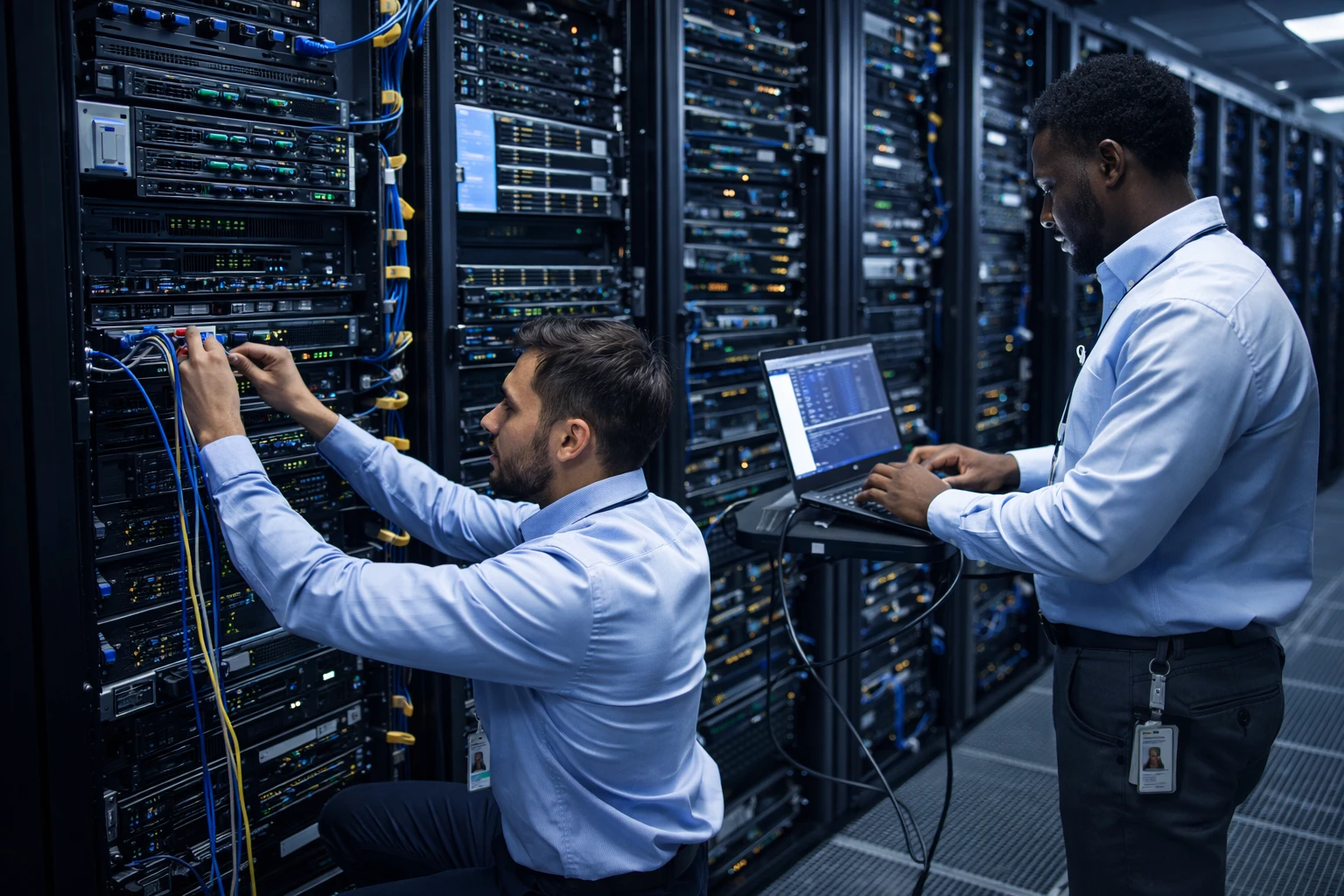
Smart Hands are an extended form of remote support that involves more highly qualified specialists and the execution of tasks that require an engineering approach. Unlike Remote Hands, this model allows for situation analysis and adaptation of actions based on the current state of the equipment.
Smart Hands do not merely execute a request but actively participate in its implementation within predefined and agreed boundaries.
Scope of responsibility
Smart Hands imply a higher level of responsibility. While architectural decisions remain with the customer, specialists are responsible for the technical correctness of actions in the given context and for adherence to sound engineering practices.
Typical Smart Hands tasks
Smart Hands are used in more complex scenarios:
- initial diagnostics of hardware failures
- component replacement without detailed step-by-step instructions
- working with RAID systems, controllers, and interfaces
- verification and adjustment of cabling schemes
- support of complex maintenance activities
- participation in migrations and equipment rearrangements
Level of expertise
Smart Hands are performed by engineers or senior technicians with experience working with server and network platforms from various vendors. At the same time, they do not replace the customer’s internal team and do not assume strategic control over the infrastructure.
Operational flexibility
Smart Hands are less standardized. SLAs often depend on task complexity, and support is typically provided on a best-effort basis or billed on an hourly basis.
Key Differences Between Remote Hands and Smart Hands
The primary difference between these models lies in the role of the executor.
Remote Hands perform predefined actions without interpretation. Smart Hands are involved in the process and may make tactical decisions within an agreed-upon scenario.
The differences become evident across several dimensions.
- Level of involvement. Remote Hands operate according to a “request – execution – confirmation” model. Smart Hands involve dialogue, clarification of conditions, and collaborative work during incidents or planned maintenance.
- Task complexity. Remote Hands are suitable for formalized operations. Smart Hands are used when multiple scenarios are possible and selecting the optimal course of action is required.
- Responsibility model. Remote Hands are responsible for the execution process, while Smart Hands are responsible for the technical correctness of execution within the given context.
- Risk profile. Errors in Remote Hands are more often related to incorrect task definition. Errors in Smart Hands can potentially have a greater impact and therefore require clearer boundaries of responsibility.
Use Cases and Practical Scenarios
In day-to-day operations, Remote Hands effectively handle routine tasks without placing unnecessary load on the engineering team. This is particularly important for highly standardized infrastructures.
In the case of hardware incidents, the situation changes. When a reboot or component replacement does not resolve the issue, Smart Hands make it possible to perform initial on-site diagnostics and avoid prolonged escalation.
During complex maintenance windows, Smart Hands provide flexibility by allowing work plans to be adjusted as tasks progress. At the same time, Remote Hands continue to be used for auxiliary and strictly formalized activities.
For distributed teams, both models serve as a way to compensate for the lack of physical presence of engineers, especially when working with data centers located in other countries and time zones.
When to Choose Remote Hands
Remote Hands are optimal when:
- the infrastructure is standardized
- all actions are documented
- limited risk is acceptable
- tasks are repetitive and predictable
They help reduce operational load and allow the internal team to focus on architecture and automation.
When to Choose Smart Hands
Smart Hands are justified when:
- the infrastructure is complex or has evolved over time
- downtime is critical to the business
- there is no immediate access to in-house engineers
- incidents require on-site analysis
In such conditions, local expertise has a direct impact on service recovery time.
How Remote Hands and Smart Hands Complement Each Other
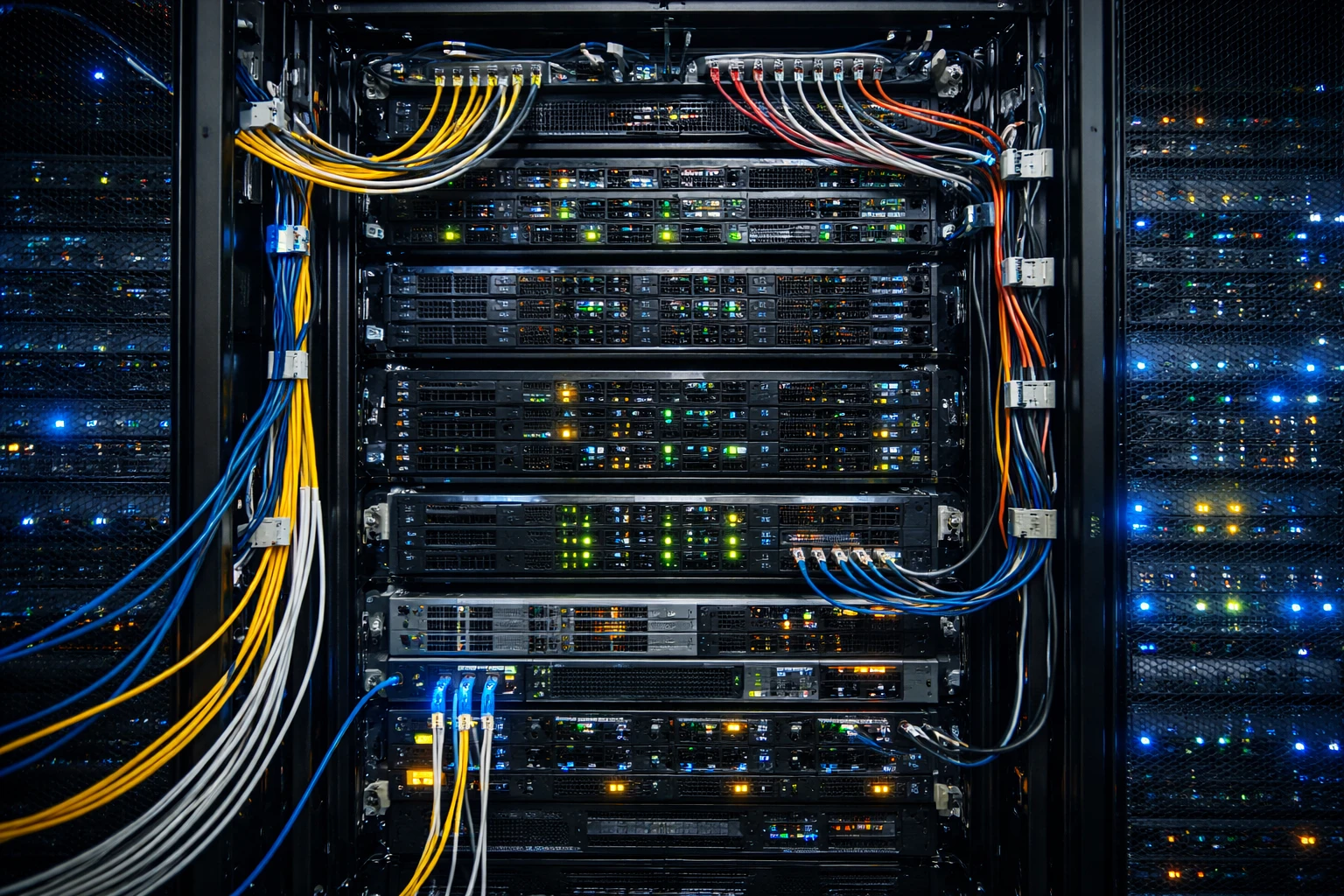
In mature infrastructures, Remote Hands and Smart Hands are used together. Remote Hands cover the baseline level of support, while Smart Hands are engaged during escalation or in non-standard scenarios. This approach helps balance operating costs, maintain process predictability, and ensure flexibility without introducing excessive risk.
Common Misconceptions
Common misconceptions include:
- treating Remote Hands and Smart Hands as the same service
- expecting Smart Hands to replace in-house engineers
- assuming that an SLA guarantees problem resolution
These misunderstandings lead to incorrect expectations and operational conflicts.
Remote Hands and Smart Hands in a Mature Operational Model
Remote Hands and Smart Hands are designed for different levels of infrastructure operations. Remote Hands provide predictable physical access to equipment, while Smart Hands add engineering flexibility where predefined instructions are no longer sufficient.
The conscious use of both models makes it possible to build a resilient operational framework, reduce incident response times, and improve the stability of distributed infrastructure without unnecessary overhead.