
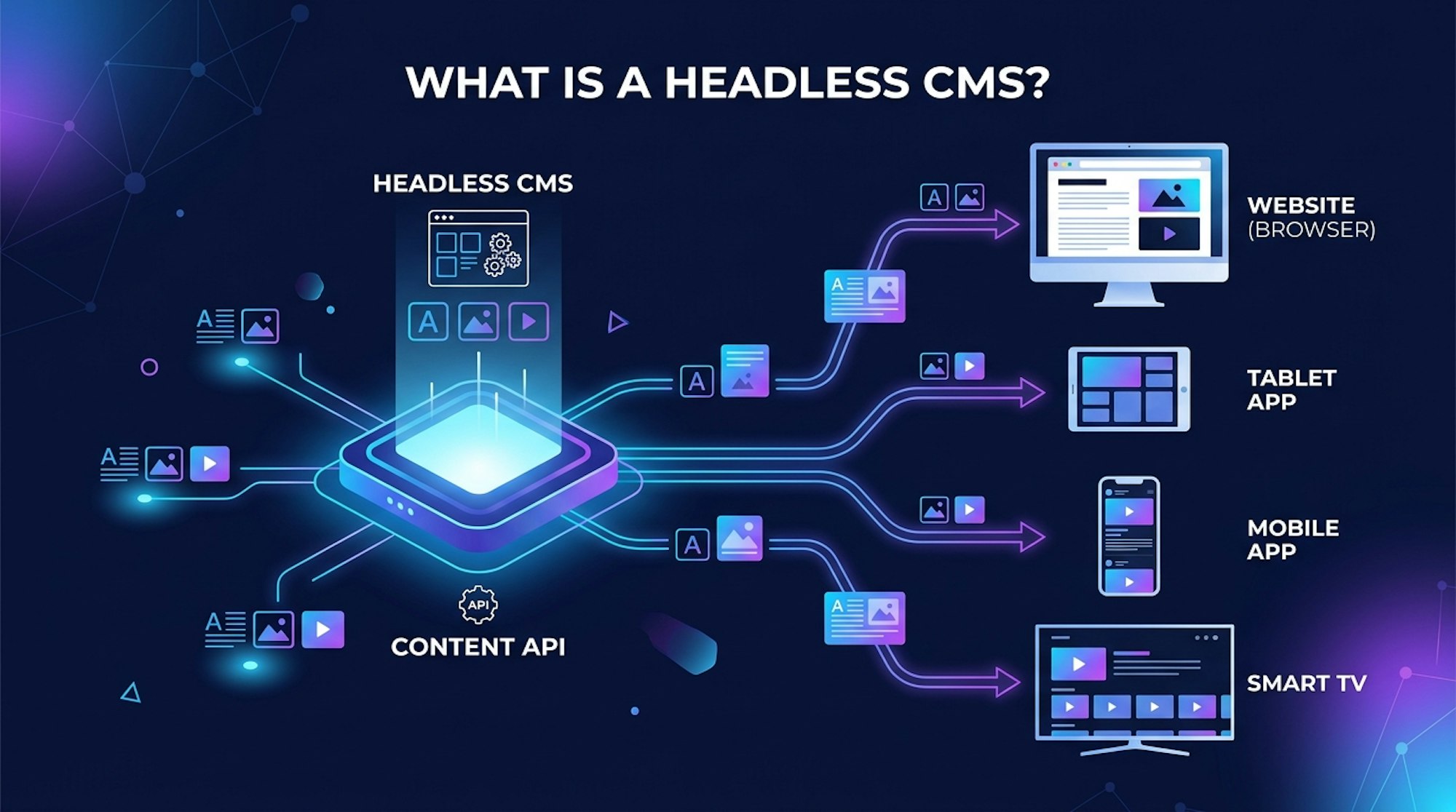
Global users expect instantaneous and homogeneous digital engagements everywhere. If information is viewed in New York, Tokyo, or even São Paulo, slow loading and delayed updates no longer allow time for users to lose faith. Many CMS applications fall behind, however, as they’ve been developed with centralized rendering and tightly-coupled frameworks, which means as traffic increases across the globe, more latency occurs along with infrastructure hurdles and operational complications. Headless CMS facilitates a framework where this no longer needs to be the case, as it separates content from delivery, providing a new architecture that facilitates sophisticated, world-renowned approaches. Instead of generating applications that merely optimize load times and information updates for regions, a headless approach allows for global CMS as if it were always highly reliable.
Separating Content from Delivery Avoids Geographic Latency Constraints
With traditional CMS solutions, rendering and delivery occur from one centralized source. When users request content from various geographic locations, each request often gets routed back to the same original origin. This network latency is aggravated the further users are from the point of content delivery. Headless CMS for better content control helps distribute content through APIs and edge networks, reducing dependency on a single origin server. The larger the demand, spread across multiple continents, the more problematic centralized rendering, creation, and caching become.
However, headless CMS solutions decouple this geography from rendering. Content is created and cached in a centralized space, but through an API, it’s sent and received by distributed frontend systems. It’s rendered closer to home (even at the edge) instead of miles away at the origin. In time, this separation means that distance is no longer a factor in rendered performance. The possibility of global delivery is fastened because the content doesn’t need to be compiled at one particular point; it can be rendered anywhere as long as it’s cached for use.
API-Driven Delivery is Decentralized and Works with Distributed Networks
Headless CMS is highly regionalized because API-driven content is lighter, stateless and easily scalable. Because APIs rely less on taking an entire page and need to work collaboratively with distribution networks, it’s easier to leverage edge technology and disperse rendering and deliveries across various locations.
Instead of assembling pages to create a singular website, a headless CMS structures data into responsive APIs that make it renderable once but potentially usable multiple times in nearby caches. It’s the perfect solution for global delivery because distributed systems can pull the content from an API once and serve it subsequently from a nearby location. This saves round-trip time and allows less of a load on the origin system. Thus, in time, API-driven delivery from a headless CMS decentralizes what would’ve been a global request into a regionalized and sufficiently speedy enterprise effort that grows in performance efficiency as demand continues.
CDN and Edge Caching Speed Global Access
Perhaps the most powerful accelerator for fast global delivery in a headless CMS architecture is aggressive caching. Since content is sent across the wire as deterministic data rather than dynamically rendered pages, it can be cached as needed at CDNs and edge nodes throughout the globe. In essence, people receive the content from a much closer source instead of a centralized location.
For global campaigns or spikes in traffic, cached content handles the vast majority of requests meaning that global access remains stable and reliable. A traditional CMS might struggle with cached pages since it relies on personalization or server-side rendering. With headless CMS, content delivery caching is a first-class citizen which means that global scale can be an advantage instead of a performance burden.
Rendering Happens Closer to Home
Perceived latency is the name of the game when it comes to rendering content for the global audience. In a headless CMS architecture, front-end applications can be deployed at will across regions via static hosting, serverless applications or edge-rendering solutions. These frontends request content from APIs and render them in their locale rather than applying effort at a distant server.
Therefore, global access performs similarly for all front-end connected users who benefit from the same resources. In time, frontend rendering becomes an optimization lever that teams can analyze separate from content management. Faster global access does not come by scaling the single backend but rendering where it makes sense to in a distributed approach.
Structured Content Enables Faster Access of Relevant Localization and Variants
Faster access to global content isn’t enough; relevant access must be provided, too. Many regions of the world require translated content, specific regional variants or regulatory compliance. For instance, a traditional CMS would have to struggle with duplicated pages and region-based sites to ensure proper editorial and technical governance.
Headless CMS drives the benefits of structured localization since the global content and region-specific variants are kept in the same model, separated by fields. Thus, the delivery can request the language or region-specific fields as necessary. Therefore, proper delivery occurs without delay. Furthermore, over time, structured localization makes global access faster because it’s easier to promote access in different regions since it only applies to one version and no duplicates are needed through various efforts.
Independent Scaling Means Regional Traffic Does Not Create Overhead for Slower Territories
Global traffic is not always homogenous. A campaign may be running in one area while another region experiences calm. Traditional CMS platforms scale as one entity, meaning spikes in one location may mean slower service in another. This is not a problem for headless CMS since the delivery infrastructure can scale independently across regions.
APIs and CDNs operate with less demand on centralized systems. Frontend deployments that might be in certain regions can scale based on localized demand without overwhelming central systems. As such, performance in the global landscape is separated which means one market spike does not slow things down elsewhere. Over time, independent scaling becomes necessary to ensure fast, reliable performance for varying geographical audiences.
Content Updates Are Registered Faster Across All Regions At Once
Global organizations rely on many content updates to be implemented across all regions all at once. Traditional CMS platforms cache invalidation methods, redeployment requisite, and regional rollout hinder standardization. With headless CMS, content can be updated once but delivery can be effective anywhere.
Content can be adjusted in the CMS while the APIs and caching adjustments are made for distributed delivery. Frontend systems can fetch without redeployment once a new cache is ready. Over time, this ability to turn around changes faster and more uniformly allows organizations to respond to real time events, market fluctuations and compliance needs where accurate information is crucial for everyone at once.
Less Load on the Backend Systems Provides Global Confidence
Putting global delivery into performance means that backend systems are strained if each request needs to go to the origin. This means the headless CMS automatically reduces workload where public-facing traffic is available for cached and distributed layers instead of relying on APIs to manage everything.
The CMS backend becomes a system for content management instead of people-facing traffic. Thus, this provides more stability and less load on the backend performance. Even if performance spikes at one end, over time core services aren’t experiencing that external traffic, making it easier to provide reliable global access without the additional infrastructure that would typically complicate things.
Increased Alignment With Globalized Infrastructure Over Time
Globalized infrastructure relies on distributed systems, serverless computing, and edge networks. Headless CMS tends to follow an approach that lacks centralized rendering or a monolith. Instead, content is a service, and as such, content fits nicely into patterns of globalized infrastructure.
This means that when changes, developments, and innovations arise in globalized delivery, organizations can adopt them without needing to retrofit across the content layer. The longer that an organization uses headless CMS, the more globalized content delivery matches patterns of infrastructure instead of the other way around.
Creates a Trusted Experience for Globalized Users
It’s not just about quick delivery; it’s also about consistent delivery. Headless CMS ensures that all globalized users receive the same content with the same messaging and experience, no matter where they are. As long as content exists in a single source of truth, it can be distributed for faster delivery, but updates will ensure that everyone gets the same ultimate version.
This consistency breeds trust and credibility to position brands with market adoption. Users aren’t confused about what they’re reading due to outdated or erroneous messaging because they are receiving the same thing as their peers in other geo locations. In the long run, consistent international delivery becomes a competitive advantage of reliability and professionalism at scale.
Performance Consistency Across High- And Low-Latency Areas
One of the biggest challenges surrounding international content delivery is performance inconsistency. Those in metropolises with well-developed technological access receive the best speeds and user experience; those in higher-latency situations with fewer development opportunities often have less speed and reliability. Conventional CMS serves to create gaps because every request relies on centralized processing.
With headless CMS, these discrepancies lessen over time. With distributed delivery and cached content, all users have access to the same resources much closer to them. Since content is served as light data and rendered by the users’ systems, performance becomes more even across regions. Over time, such performance consistency increases user satisfaction, bridging the gap between core and edge markets. International operations shouldn’t become limited by access; headless CMS creates even experiences from day one.
Allowing for Global Rollouts without Regional Coordination Limitations
Often when a change is made to content, it needs to be rolled out to regions in succession to avoid mismatches, gaps, or unresolved issues as content isn’t universally available at first. In a traditional CMS setup, this means separate regional sites or sites in different instances that can have delays in getting the same updates.
With headless CMS, there’s a simplified approach since delivery is decentralized but content management is centralized. A content team makes one update and the delivery systems will ensure it reaches all regions at the same time. There isn’t a need for staggered options or regional engagement unless that’s the goal. Over time, this means that brands can move quickly and have confidence that global launches, announcements or urgent updates can all go out and be received and engaging as one across the board without worrying about the pitfalls of human intervention to coordinate efforts. Global is a system feature rather than a logistical struggle.
Allowing for Regional Customization Without Slowing Down Global Delivery
However, just because things are globally fast does not mean that everything is the same content everywhere. Often regions need disclaimers, legal requirements or region-specific messaging. Headless CMS bridges this gap by allowing for the same fields across a content model to have adjustable variations that the delivery system can pull based on region/language without sacrificing speed.
Since it’s all still in the same approach but configured, globalization does not sacrifice regional relevance. Over time this means that brands who might want to tap into localized messaging don’t have to rebuild their structure but can expand without compromising speed. Instead, the speed can only enhance what’s possible before regions instead of sacrificing global delivery based on headless CMS offering regional customization.
Making Global Scale a Performance Enhancer Instead of an Added Risk
Often in standard architecture, global scale adds risk. The more people accessing one site, the more strain on a centralized approach, more complications emerge and failures seem destined to happen. Headless CMS flips the script and instead makes global scale a performance enhancement.
Distributed caching and edge rendering means that more people accessing something is beneficial their access helps strengthen caches instead of putting too much strain on one origin site. As international use grows, the traffic is absorbed across the continents instead of one thing weighing down too much demand in a given area. Over time this means that brands can successfully grow international operations without fear that more access will compromise what’s possible with good performance support. Instead, with headless CMS, optimization is built in from the start.